
Where to Hang Art in Your Home: A Room-by-Room Guide
Most people don't get art wrong because they picked the wrong piece. They get it wrong because of where they hang it: too high, too small for the wall, floating with nothing to anchor it. I see it constantly when I'm doing room visualizations for collectors. The painting's right. The placement isn't.
So here's the guide I wish I'd had when I started selling into actual homes instead of just painting for myself. Room by room, with real numbers, not the usual "trust your eye" advice.
The one rule that applies everywhere
Centre of the artwork sits at 57 to 60 inches (145 to 152 cm) from the floor. That's the standard museum eye-level height. It's based on average eye height when you're standing, not on whatever furniture happens to be underneath. If you take one number away from this post, take that one.
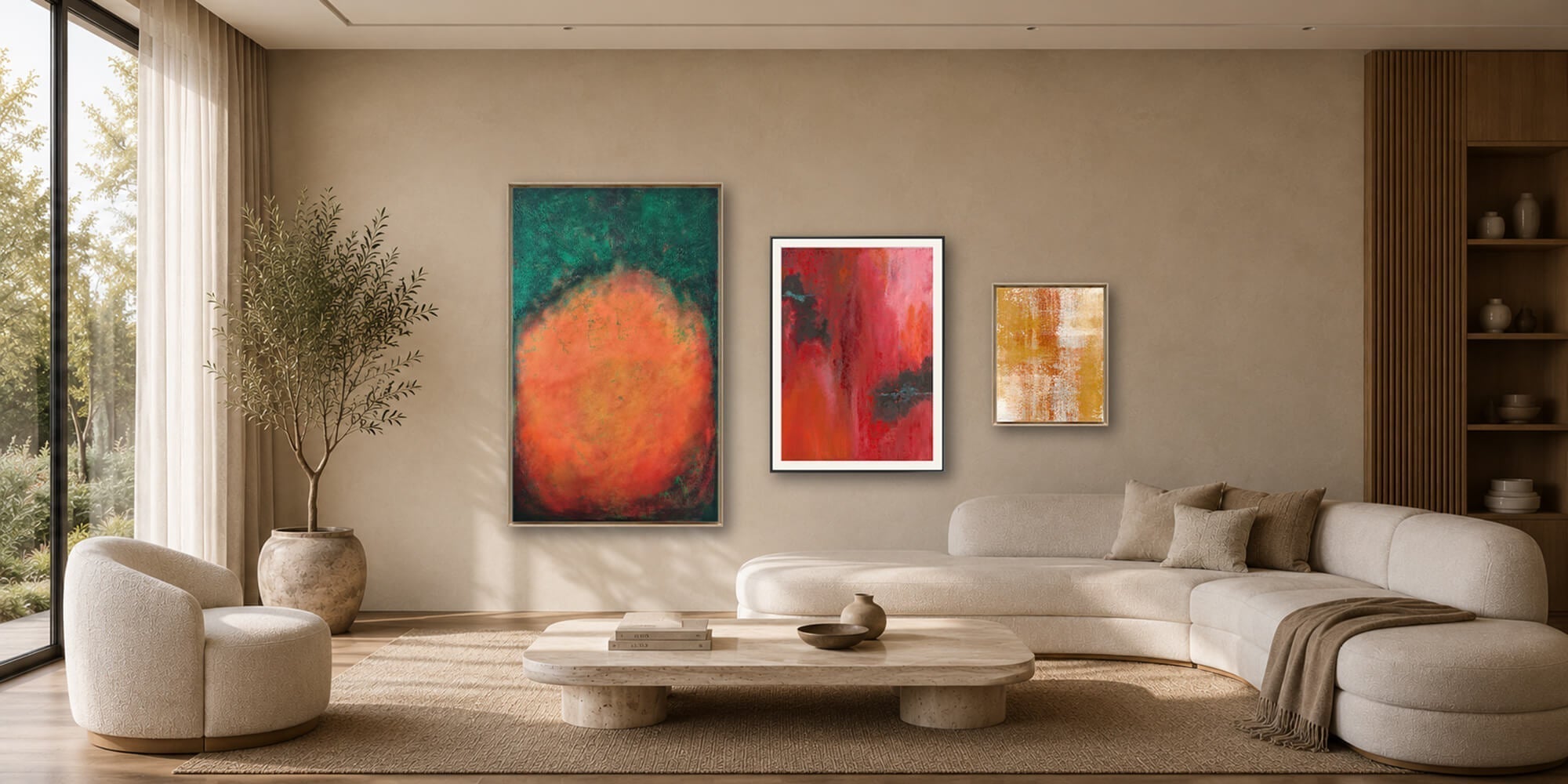
There's an exception. Art hung above furniture, a sofa, console or headboard, sits a bit lower. Leave 6 to 10 cm between the top of the furniture and the bottom of the frame. Enough to feel connected to what's beneath it, not so little that it looks like it's resting on the sofa.

Living room
Scale matters most here, because living rooms have the most wall and the most furniture competing for attention. A painting that felt generous in the studio, or on your screen, can shrink to nothing above a large sofa.
Rough guide: the artwork should span about two-thirds to three-quarters the width of whatever's below it. Above a 2.4 m sofa, that puts you around 1.6 to 1.8 m, or a grouping considered enough to read as one block. Go too small and it looks like an afterthought. Go too big and it starts fighting the room instead of anchoring it.
If your sofa faces a feature wall with nothing beneath the art, you've got more freedom. Just make sure the piece has enough presence to hold the wall on its own.

Bedroom
Same 6 to 10 cm rule above the headboard, but bedrooms ask for something calmer than living rooms. This is a room for quieter movement and warmer tones, something you want to wake up to rather than be jolted by. Match the width of the piece, or the grouping, to roughly the width of the bed rather than the whole wall.
If the headboard's upholstered or has some height to it, measure from the top of the headboard rather than the floor. The 6 to 10 cm gap still applies from there.
Dining room
Dining rooms give you the most flexibility, since you're usually hanging to a wall rather than a piece of furniture. Standard eye-level height still holds, but remember the room's used seated as much as standing. If most of the time spent in there is at the table, hang a touch lower than the standard 57 to 60 inches, closer to seated eye level, especially for a single statement piece across from the table.
Entryway and hallway
The entryway sets the tone for the whole home, and it's one of the few places where a smaller piece can punch above its weight. First impressions don't need scale so much as presence. Standard eye-level height applies, and it's a good spot for something with an immediate read, since nobody stands in a hallway studying art for five minutes.
For a run of frames down a long hallway, keep the spacing even, 6 to 8 cm apart, and line up all the centers on that same 57 to 60 inch line even if the pieces are different sizes. A consistent centerline looks intentional. Consistent top edges usually don't.
Home office
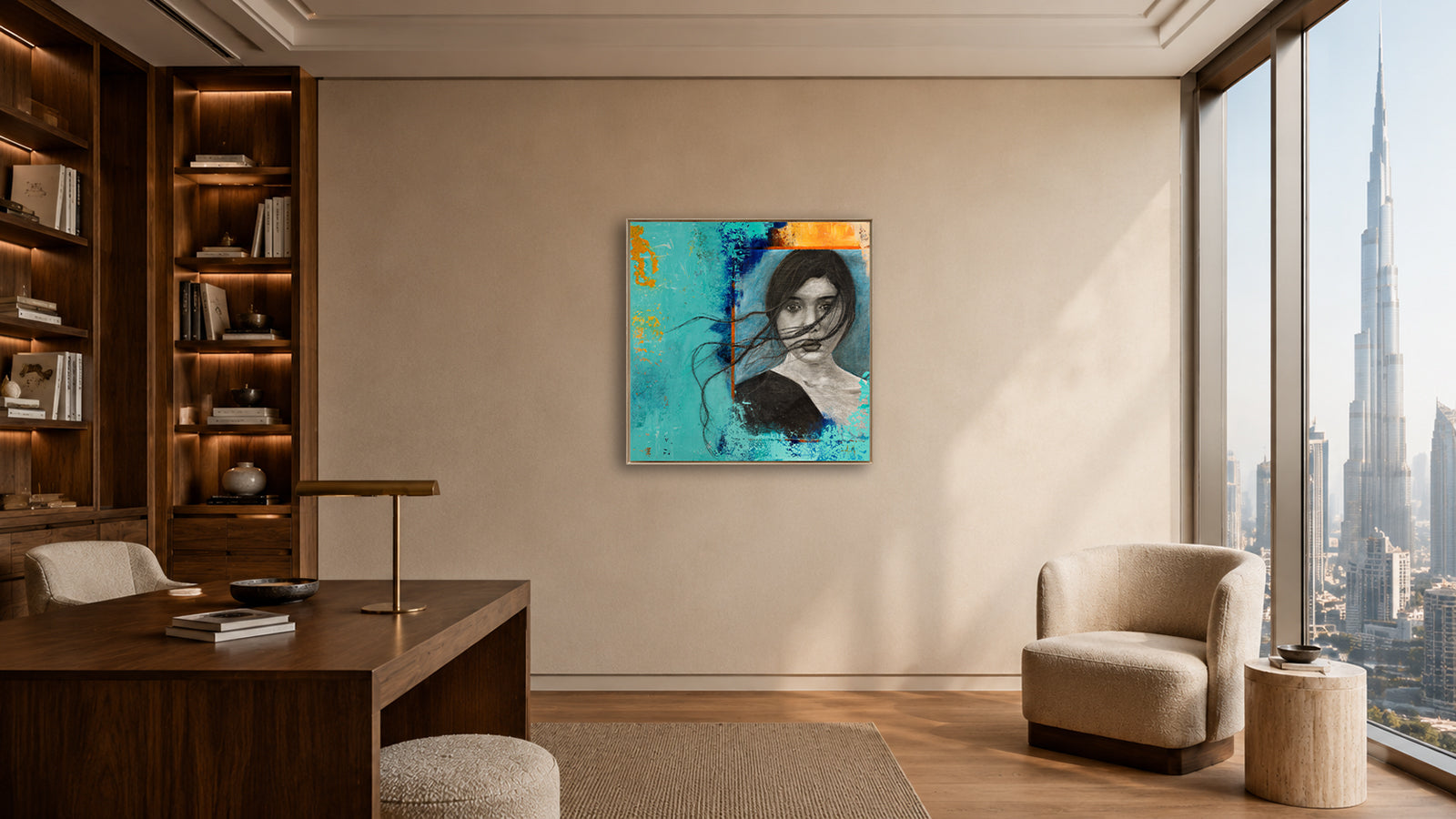
This is the one room where I'd break the standing eye-level rule. You're sitting at a desk for hours, so hang relative to seated eye height, and think about what shows up behind you on video calls if that matters for your work. A piece that's visible while you're sitting does more day-to-day work than one you only glance at on your way out of the room.
A few things that trip people up
- Ceiling height isn't eye level. Tall ceilings tempt people to hang higher to fill the space. Don't. The 57 to 60 inch rule holds no matter how high the ceiling goes. If you want to fill height, go bigger on the piece or the frame, not higher on the wall.
- Groupings count as one piece. Hanging two or three works together? Measure the centre of the whole group against the 57 to 60 inch line, with 5 to 8 cm between each piece.
-
Light changes things through the day. Mixed-media and textured work especially can look different in morning light versus evening light. If you can, check the wall a couple of times before you commit to the final hook position.
If you're not sure
This is exactly what a room visualization is for. Send me a photo of your wall on Instagram and I'll show you the piece in your actual space, at the right scale, before you commit to anything. It's a five-minute favor I'm always happy to do. Message me here.
And if you're still deciding what to hang in the first place, my guide to choosing the right size painting for your space is worth a read next.

Leave a comment
This site is protected by hCaptcha and the hCaptcha Privacy Policy and Terms of Service apply.